
- List of all cryptocurrencies
- Why do all cryptocurrencies rise and fall together
- Are all cryptocurrencies mined
All the cryptocurrencies
The growth of mobile payments is also supported by the increasing penetration of smartphones and improved internet connectivity. Moreover, innovations such as biometric authentication and tokenisation have enhanced the security of mobile payments, addressing concerns about fraud and data breaches https://ripworkoutsale.com.
While all forms of digital money offer near-instant payment capabilities at low fees there are important differences among them. CBDCs (Central Bank Digital Currencies) are legal tender and ideally suited as means of payment. However, as they are still in concept or pilot phase, they are not yet available for real-world use cases at scale.
Another example is intra-company money transfers. Digital currencies are an ideal means of transferring money swiftly and without any hassle between subsidiaries and headquarters. Stablecoins, as well as commercial bank money tokens, are a good choice for this use case.
List of all cryptocurrencies
Each of our coin data pages has a graph that shows both the current and historic price information for the coin or token. Normally, the graph starts at the launch of the asset, but it is possible to select specific to and from dates to customize the chart to your own needs. These charts and their information are free to visitors of our website. The most experienced and professional traders often choose to use the best crypto API on the market. Our API enables millions of calls to track current prices and to also investigate historic prices and is used by some of the largest crypto exchanges and financial institutions in the world. CoinMarketCap also provides data about the most successful traders for you to monitor. We also provide data about the latest trending cryptos and trending DEX pairs.
Each of our coin data pages has a graph that shows both the current and historic price information for the coin or token. Normally, the graph starts at the launch of the asset, but it is possible to select specific to and from dates to customize the chart to your own needs. These charts and their information are free to visitors of our website. The most experienced and professional traders often choose to use the best crypto API on the market. Our API enables millions of calls to track current prices and to also investigate historic prices and is used by some of the largest crypto exchanges and financial institutions in the world. CoinMarketCap also provides data about the most successful traders for you to monitor. We also provide data about the latest trending cryptos and trending DEX pairs.
These crypto coins have their own blockchains which use proof of work mining or proof of stake in some form. They are listed with the largest coin by market capitalization first and then in descending order. To reorder the list, just click on one of the column headers, for example, 7d, and the list will be reordered to show the highest or lowest coins first.
NFTs are multi-use images that are stored on a blockchain. They can be used as art, a way to share QR codes, ticketing and many more things. The first breakout use was for art, with projects like CryptoPunks and Bored Ape Yacht Club gaining large followings. We also list all of the top NFT collections available, including the related NFT coins and tokens.. We collect latest sale and transaction data, plus upcoming NFT collection launches onchain. NFTs are a new and innovative part of the crypto ecosystem that have the potential to change and update many business models for the Web 3 world.
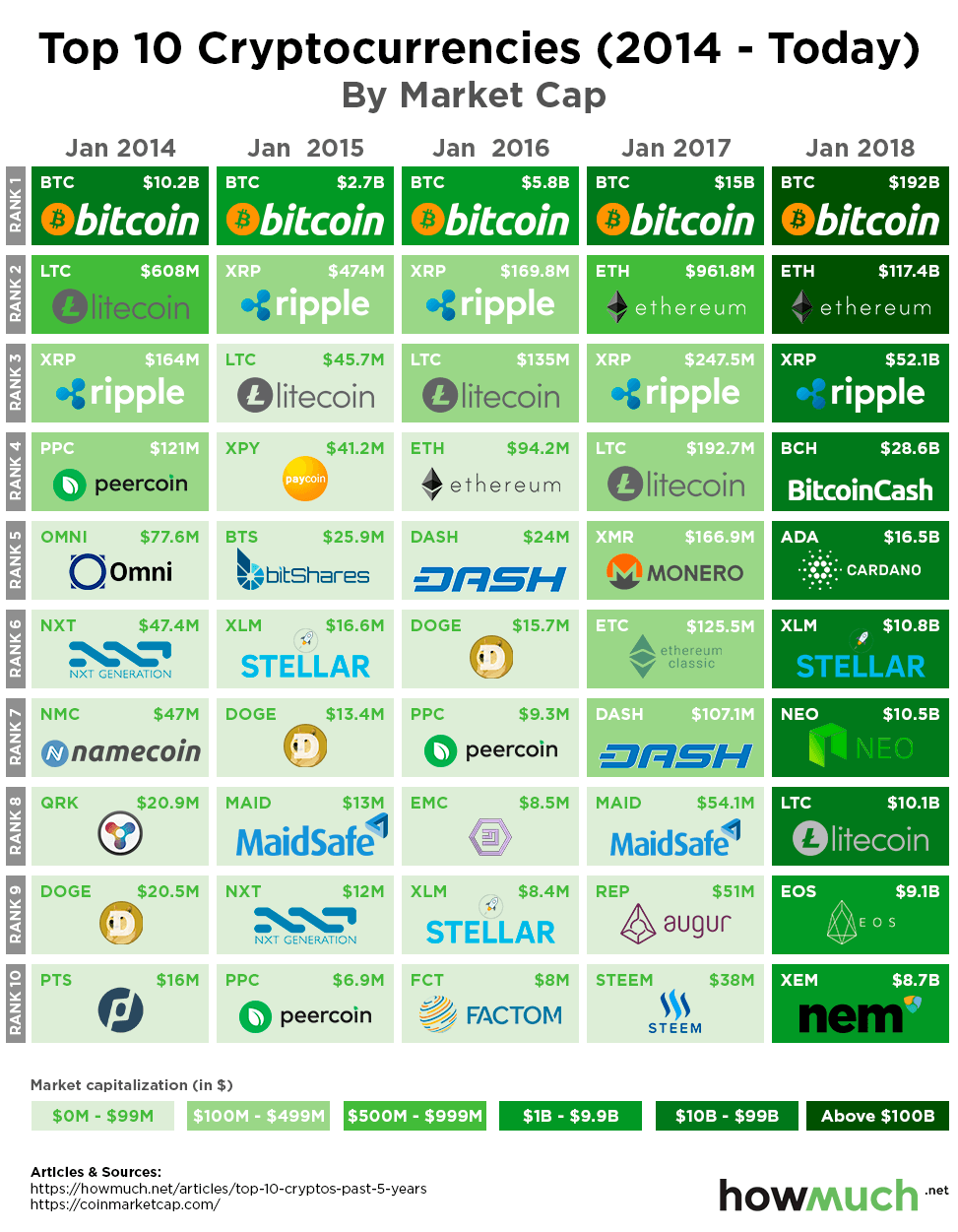
The very first cryptocurrency was Bitcoin. Since it is open source, it is possible for other people to use the majority of the code, make a few changes and then launch their own separate currency. Many people have done exactly this. Some of these coins are very similar to Bitcoin, with just one or two amended features (such as Litecoin), while others are very different, with varying models of security, issuance and governance. However, they all share the same moniker — every coin issued after Bitcoin is considered to be an altcoin.
The first chain to launch smart contracts was Ethereum. A smart contract enables multiple scripts to engage with each other using clearly defined rules, to execute on tasks which can become a coded form of a contract. They have revolutionized the digital asset space because they have enabled decentralized exchanges, decentralized finance, ICOs, IDOs and much more. A huge proportion of the value created and stored in cryptocurrency is enabled by smart contracts.
Why do all cryptocurrencies rise and fall together
Different cryptos come with varying visions regarding the direction of their project. Besides, the quality of the blockchains housing them is also an important price-determining factor. Coming to the project, the overall security and network adoption make the related blockchain crypto move up or down in terms of prices. The desirable metric here is to have a growing number of nodes, which indicates a strong and growing community. Further, an increasing number of nodes makes the project sufficiently decentralized. Hence, more brownie points for the project and the related crypto.
One day, you may see a coin skyrocketing to new heights; the next, it plunges into the abyss. But what exactly drives these rollercoaster rides in the world of digital currencies? Let’s delve into the factors behind the rise and fall of cryptocurrency prices, demystifying this intriguing phenomenon.
Cryptocurrencies, despite their distinct features and purposes, often show a synchronized movement in the market. Several factors contribute to this synchronization, leading to simultaneous rise and fall in the value of different cryptocurrencies.
Government policies can either boost or hurt cryptocurrency prices. Positive regulations, like legalizing crypto, often increase demand. On the other hand, bans or heavy restrictions can lead to price drops as investors lose confidence.
Are all cryptocurrencies mined
You’re reading a free article with opinions that may differ from The Motley Fool’s Premium Investing Services. Become a Motley Fool member today to get instant access to our top analyst recommendations, in-depth research, investing resources, and more. Learn More
The competition between these blocks continues until the next block is mined on top of one of the competing blocks. When a new block is mined, whichever block came before it is considered the winner. The block that is then abandoned is called an orphan block or a stale block, which causes all the miners who picked that block to switch back to mining the chain of the winning block.
Imagine a global digital ledger where every cryptocurrency transaction is recorded. Mining ensures this ledger stays accurate and secure. Miners use specialized computers to solve puzzles (essentially guessing numbers) to organize and confirm pending transactions. The first one to solve it gets rewarded with cryptocurrency.
Given the substantially lower costs associated with proof-of-stake, you might think it’s a better way to validate transactions. It does, however, still have downsides. For example, even though there’s no concern that an entity can gain control over 51% of a network’s computing power with proof-of-stake, if an entity could gain control of 51% of all outstanding tokens it could hold the network and its stakeholders hostage. Of course, there’s not much likelihood this will happen with high-market-cap digital currencies. However, virtual currencies with low market caps may be susceptible to this vulnerability.
As new blockchain transactions are made, they are sent to a pool called a memory pool (or mempool). Validating nodes are responsible for verifying the validity of transactions. The job of a miner is to collect these pending transactions and organize them into blocks. Note that some miners also run validating nodes, but mining nodes and validating nodes are technically different.

